Temporal Leakage in LLM Backtesting: Measurement, Validation, and Adjusted Scores
Zeyu Zhang and Bradly C. Stadie
The standard pre/post contamination check for LLM backtests is uninformative: recency alone reproduces the leakage signature, and no passive backtest can separate leakage from skill and recency. One external reference—a known cutoff or a matched clean control—restores measurement and yields a leakage-adjusted score, validated by planting leakage in twin models and deployed as an audit of frontier systems.
The standard check for contamination in LLM backtests is simple: compare scores before and after the training cutoff. We show this check is uninformative. Four flagship models fail it on questions they cannot have memorized: every scored question resolved after their cutoffs. The reason is structural. Models legitimately know more about times near their cutoff, so recency mimics leakage, and we prove no passive backtest can separate the two from genuine skill. Measurement, not just detection, requires information from outside the backtest. We supply it in two forms. A known cutoff identifies leakage at the boundary; a matched clean control identifies it globally and yields a leakage-adjusted score. We also derive where leakage hides: it concentrates on outcomes that surprised the crowd and were well covered in training, and partial memorization is disproportionately rewarded. We validate the estimators against ground truth by planting leakage in twin models, where they recover the injected dose and return null on clean questions. Deployed on frontier models, they detect one cutoff-localized signature and, at the audit’s power floor, clear five models whose apparent advantages were recency alone. Backtests need not be discarded; they need one defensible reference.
@misc{zhang2026leakage,title={Temporal Leakage in LLM Backtesting: Measurement, Validation, and Adjusted Scores},author={Zhang, Zeyu and Stadie, Bradly C.},year={2026},archiveprefix={arXiv},primaryclass={cs.LG},url={https://arxiv.org/abs/2608.02985},}
TEMPO
TEMPO: Temporal Enforcement via Mode-Separated Policy Optimization for Trustworthy LLM Backtesting
Zeyu Zhang and Bradly C. Stadie
Temporal leakage lets LLMs recall post-cutoff outcomes during backtesting, so reported accuracy is often invalid. TEMPO trains temporal discipline with a two-mode RL objective that first drives leaked claims to zero, then optimizes prediction quality once reasoning stays pre-cutoff, with theory and experiments showing large leakage reductions without sacrificing performance when valid signals exist.
Backtesting large language models on historical events requires reasoning exclusively from information available before a specified cutoff date. Yet models routinely leak post-cutoff knowledge from pre-training into their reasoning, inflating apparent accuracy and undermining evaluation validity. Prompt-based constraints fail when suppressed content is causally related to the prediction, and knowledge unlearning cannot address this problem because temporal compliance is instance-specific: the same fact may be legitimate evidence for one cutoff date and a violation for another. Rather than erasing knowledge, the model must learn temporal discipline: selecting evidence conditioned on each instance’s cutoff date. We propose TEMPO (Temporal Enforcement via Mode-separated Policy Optimization), which trains this discipline via two contributions: (1) a two-mode reward where a leakage mode drives post-cutoff claims to zero as a hard prerequisite before a performance mode optimizes task performance; and (2) a GRPO-based training pipeline that enables the model to discover temporally valid reasoning strategies. We prove that training monotonically decreases leakage, converges to the leak-free optimum, and improves task performance once compliance is achieved. On three prediction tasks and two models, TEMPO reduces leakage from 2–13% to 0.6–3.7% across all conditions, with task performance improving 6–13% where strong pre-cutoff signals exist and maintained where the prediction task is inherently difficult from valid information alone.
@misc{zhang2026tempo,title={TEMPO: Temporal Enforcement via Mode-Separated Policy Optimization for Trustworthy LLM Backtesting},author={Zhang, Zeyu and Stadie, Bradly C.},year={2026},archiveprefix={arXiv},primaryclass={cs.LG},url={https://arxiv.org/abs/2605.18843},}
TimeSPEC
All Leaks Count, Some Count More: Interpretable Temporal Contamination Detection and Mitigation in LLM Backtesting
Zeyu Zhang, Ryan Chen, and Bradly C. Stadie
Backtesting assumes models use only pre-cutoff evidence, but pretrained LLMs routinely leak later knowledge into their rationales. We introduce Shapley-DCLR to measure how much decision-critical reasoning is contaminated at the claim level, and TimeSPEC, an inference-time supervisor that regenerates predictions from temporally filtered evidence without retraining.
In Findings of the Association for Computational Linguistics: EMNLP 2026, 2026
Backtesting LLMs on resolved events assumes models reason only from pre-cutoff knowledge, yet pretrained models inevitably leak post-cutoff knowledge. We introduce a claim-level evaluation framework that decomposes prediction rationales into atomic claims and applies Shapley values to quantify each claim’s decision impact, yielding Shapley-DCLR (Shapley-weighted Decision-Critical Leakage Rate) – an interpretable metric measuring what fraction of decision-driving reasoning is contaminated. We further propose TimeSPEC (Time-Supervised Prediction with Extracted Claims), an inference-time architecture that interleaves temporally-filtered retrieval with claim-level supervision, producing predictions grounded entirely in pre-cutoff evidence. Across three LLMs, the ablation experiments confirm retrieval and supervision are jointly necessary; and a three-task probe further illstrates that the performance cost of temporal enforcement scales with each task’s reliance on post-cutoff information.
@inproceedings{zhang2026allleaks,title={All Leaks Count, Some Count More: Interpretable Temporal Contamination Detection and Mitigation in LLM Backtesting},author={Zhang, Zeyu and Chen, Ryan and Stadie, Bradly C.},booktitle={Findings of the Association for Computational Linguistics: EMNLP 2026},year={2026},archiveprefix={arXiv},primaryclass={cs.AI},url={https://arxiv.org/abs/2602.17234},}
Off-Policy LTR
Unified Off-Policy Learning to Rank: a Reinforcement Learning Perspective
Zeyu Zhang, Yi Su, Hui Yuan, and 5 more authors
Most off-policy LTR methods assume a specific click model and need custom debiasing for each setting. We cast ranking under general stochastic click models as an MDP and propose CUOLR, a click-model-agnostic offline RL approach that learns from logged clicks without prior knowledge of the click process, outperforming prior methods across large-scale benchmarks.
In Advances in Neural Information Processing Systems, 2023
Off-policy Learning to Rank (LTR) aims to optimize a ranker from data collected by a deployed logging policy. However, existing off-policy learning to rank methods often make strong assumptions about how users generate the click data, i.e., the click model, and hence need to tailor their methods specifically under different click models. In this paper, we unified the ranking process under general stochastic click models as a Markov Decision Process (MDP), and the optimal ranking could be learned with offline reinforcement learning (RL) directly. Building upon this, we leverage offline RL techniques for off-policy LTR and propose the Click Model-Agnostic Unified Off-policy Learning to Rank (CUOLR) method, which could be easily applied to a wide range of click models. Through a dedicated formulation of the MDP, we show that offline RL algorithms can adapt to various click models without complex debiasing techniques and prior knowledge of the model. Results on various large-scale datasets demonstrate that CUOLR consistently outperforms the state-of-the-art off-policy learning to rank algorithms while maintaining consistency and robustness under different click models.
@inproceedings{zhang2023unified,title={Unified Off-Policy Learning to Rank: a Reinforcement Learning Perspective},author={Zhang, Zeyu and Su, Yi and Yuan, Hui and Wu, Yiran and Balasubramanian, Rishab and Wu, Qingyun and Wang, Huazheng and Wang, Mengdi},booktitle={Advances in Neural Information Processing Systems},volume={36},pages={19887--19907},year={2023},publisher={Curran Associates, Inc.},editor={Oh, A. and Naumann, T. and Globerson, A. and Saenko, K. and Hardt, M. and Levine, S.},url={https://arxiv.org/abs/2306.07528},}
Co-authored Publications
LAMP
LAMP: Extracting Locally Linear Decision Surfaces from LLM World Models
Ryan Chen, Youngmin Ko, Zeyu Zhang, and 5 more authors
Fluent LLM explanations need not track what actually drives the prediction. LAMP treats the model’s own stated factors as coordinates and fits a local linear decision surface, without gradients or internal access, to test whether predictions move consistently when those factors change, enabling lightweight auditing of proprietary models (AISTATS 2026 Spotlight).
Spotlight paper in International Conference on Artificial Intelligence and Statistics, 2026
We introduce LAMP (Local Attribution Mapping Probe), a method that shines light onto a black-box language model’s decision surface and studies how reliably a model maps its stated reasons to its reported predictions by approximating a decision surface. LAMP treats the model’s own self-reported explanations as a coordinate system and fits a locally linear surrogate that links those weights to the model’s output. By doing so, it reveals how much the stated factors steer the model’s decisions. We apply LAMP to three tasks: sentiment analysis, controversial-topic detection, and safety-prompt auditing. Across these tasks, LAMP reveals that many language models’ locally approximated linear decision landscapes overall agree with human judgments on explanation quality and, on a clinical case-file data set, align with expert assessments. Since LAMP operates without requiring access to model gradients, logits, or internal activations, it serves as a practical and lightweight framework for auditing proprietary language models, and enabling assessment of whether a model appears to behave consistently with the explanations it provides.
@inproceedings{chen2025lamp,title={LAMP: Extracting Locally Linear Decision Surfaces from LLM World Models},author={Chen, Ryan and Ko, Youngmin and Zhang, Zeyu and Cho, Catherine and Chung, Sunny and Giuffré, Mauro and Shung, Dennis L. and Stadie, Bradly C.},booktitle={International Conference on Artificial Intelligence and Statistics},year={2026},archiveprefix={arXiv},primaryclass={cs.LG},url={https://arxiv.org/abs/2505.11772},}
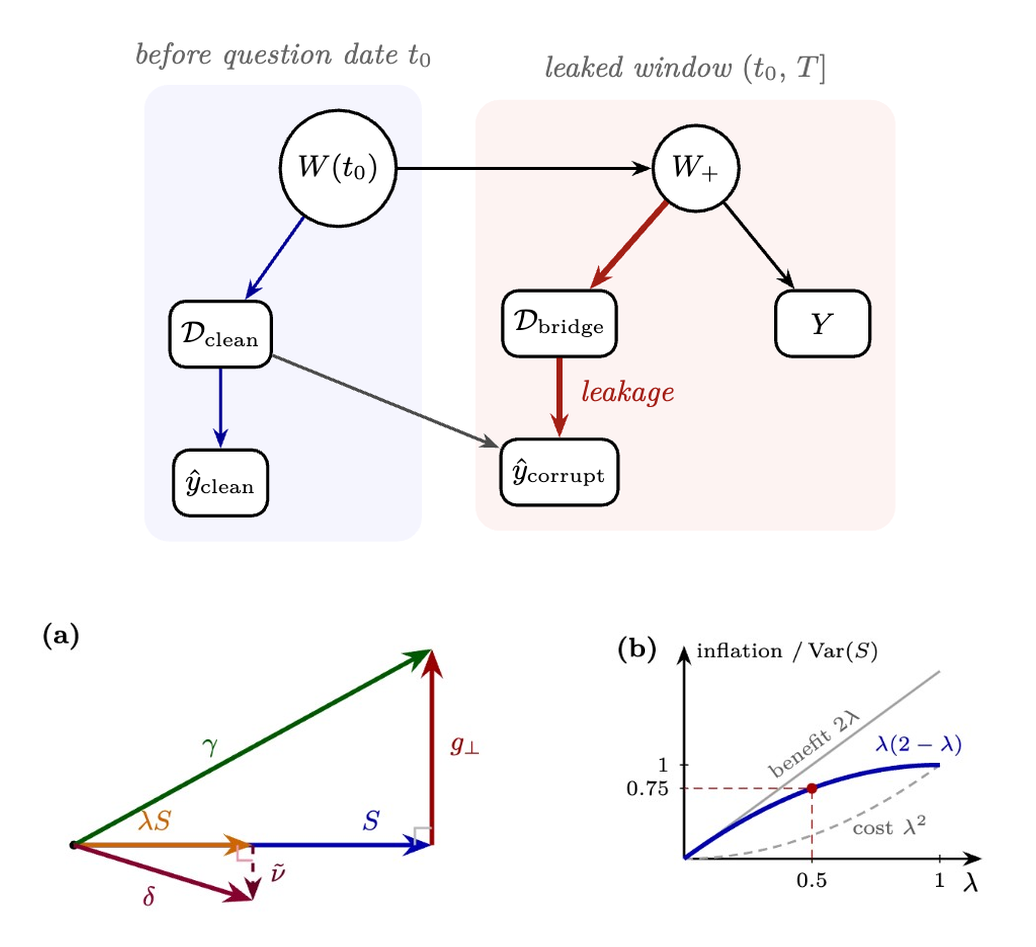 Leakage AuditTemporal Leakage in LLM Backtesting: Measurement, Validation, and Adjusted ScoresThe standard pre/post contamination check for LLM backtests is uninformative: recency alone reproduces the leakage signature, and no passive backtest can separate leakage from skill and recency. One external reference—a known cutoff or a matched clean control—restores measurement and yields a leakage-adjusted score, validated by planting leakage in twin models and deployed as an audit of frontier systems.Preprint, In submission to TMLR
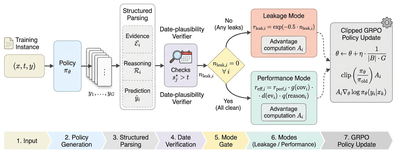 TEMPOTEMPO: Temporal Enforcement via Mode-Separated Policy Optimization for Trustworthy LLM BacktestingTemporal leakage lets LLMs recall post-cutoff outcomes during backtesting, so reported accuracy is often invalid. TEMPO trains temporal discipline with a two-mode RL objective that first drives leaked claims to zero, then optimizes prediction quality once reasoning stays pre-cutoff, with theory and experiments showing large leakage reductions without sacrificing performance when valid signals exist.Preprint, Under review at NeurIPS 2026
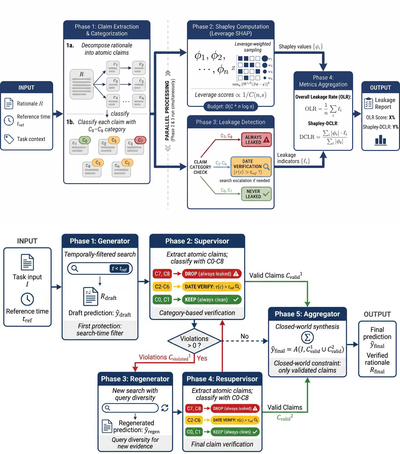 TimeSPECAll Leaks Count, Some Count More: Interpretable Temporal Contamination Detection and Mitigation in LLM BacktestingBacktesting assumes models use only pre-cutoff evidence, but pretrained LLMs routinely leak later knowledge into their rationales. We introduce Shapley-DCLR to measure how much decision-critical reasoning is contaminated at the claim level, and TimeSPEC, an inference-time supervisor that regenerates predictions from temporally filtered evidence without retraining.In Findings of the Association for Computational Linguistics: EMNLP 2026, 2026
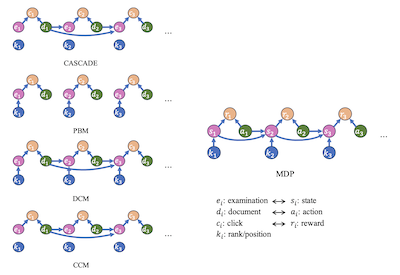 Off-Policy LTRUnified Off-Policy Learning to Rank: a Reinforcement Learning PerspectiveMost off-policy LTR methods assume a specific click model and need custom debiasing for each setting. We cast ranking under general stochastic click models as an MDP and propose CUOLR, a click-model-agnostic offline RL approach that learns from logged clicks without prior knowledge of the click process, outperforming prior methods across large-scale benchmarks.In Advances in Neural Information Processing Systems, 2023
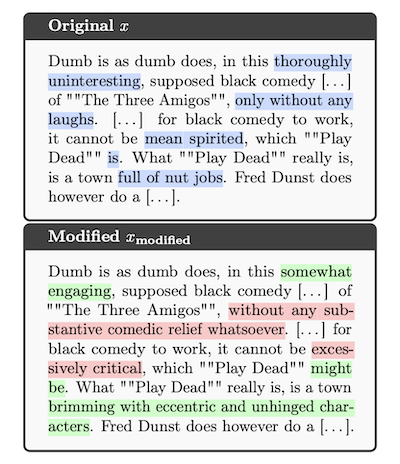 LAMPLAMP: Extracting Locally Linear Decision Surfaces from LLM World ModelsFluent LLM explanations need not track what actually drives the prediction. LAMP treats the model’s own stated factors as coordinates and fits a local linear decision surface, without gradients or internal access, to test whether predictions move consistently when those factors change, enabling lightweight auditing of proprietary models (AISTATS 2026 Spotlight).Spotlight paper in International Conference on Artificial Intelligence and Statistics, 2026